Collector profiles
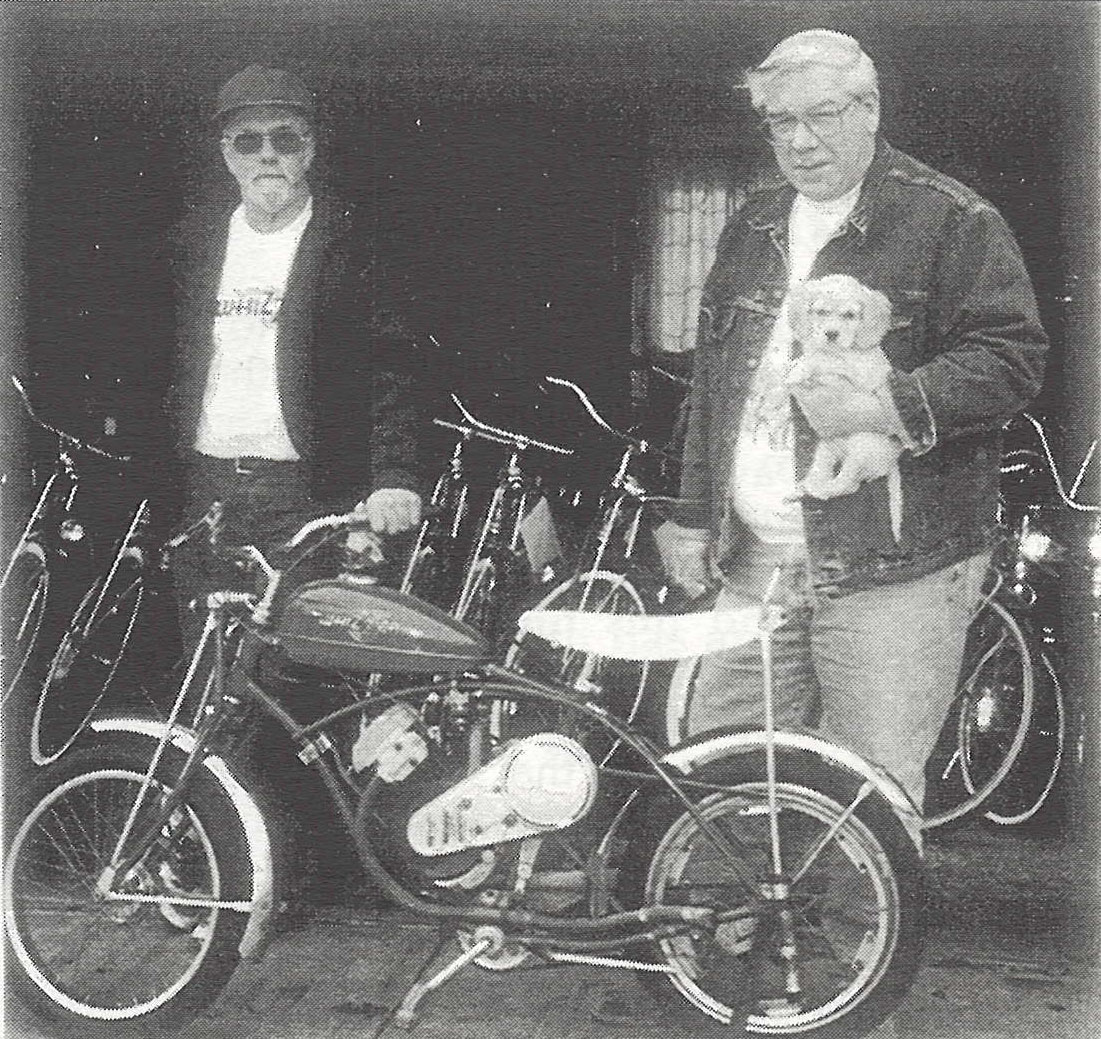
A Stroll Down Memory Lane With Larry And Harve
Finding parts for old bikes and Whizzers isn’t as easy as going to your local Ace hardware. Or is it? A trip to Memory Lane in Perrysburg, Ohio, is like a trip back in time, with aisle after aisle of hard to find NOS stock. But you know that. What you might not know is how it all got started. Well, let’s talk to Larry Busch and Harvey Trombley and find out.
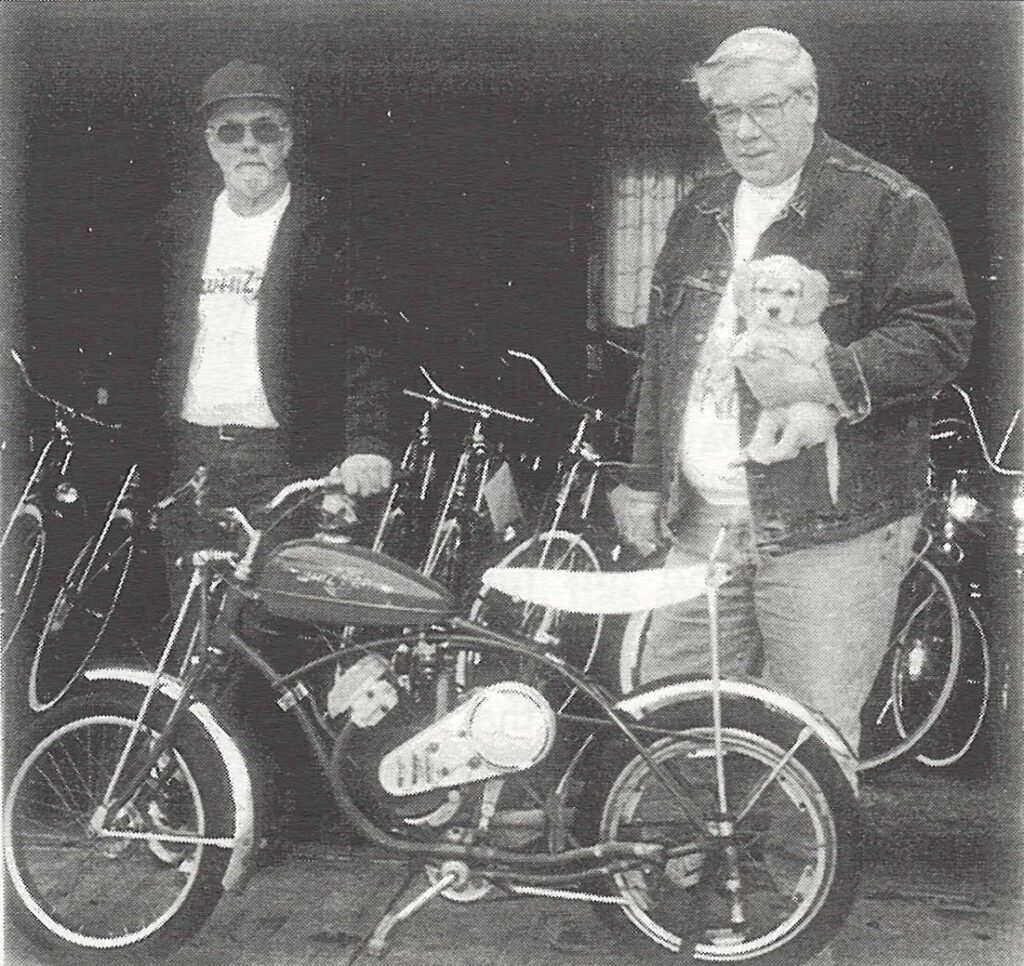
Q: You and Harve must have a passion for bikes to amass an inventory like this. Why don’t you tell our readers a little about how you guys got started.
Larry: I guess, like most everybody our age, I wanted a Whizzer motorbike when I was a kid. That was the thing back in the fifties. I remember baling hay back when I was about 13 or 14 years old. I saved up $85 and my dad drove me over to where one was for sale. You hear everybody talking today about how Whizzers never ran when they were a kid, but mine ran fine. I rode it all over the place and never did anything more than change the oil and a spark plug or two. I finally sold it two years later for what I paid for it.
I’ve always been around bicycles because my granddad had a bike shop back in the forties. So years later, back in the seventies when I was working for UPS, I just naturally started fixing up old bikes and reselling them on the side. Then one of the guys at work asked if I could fix him up with a 20 inch bike for his daughter and before I knew it I had three of them. So I put an ad in the paper and got 35 phone calls on the three bicycles. One thing led to another and I ended up renting an old restaurant in Rudolph, Ohio just to store the stuff. I remember one Memorial Day weekend, I put over 40 bikes out for sale and by Monday I had three left.
Every now and then I’d stop in at Frederick’s bike shop in Cleveland for parts. He’d get a smudge on a seat or something and just throw it in an old barrel in the back. So I’d go in and pick stuff out for the price of scrap. I’d get a real nice seat for fifty cents. I could also get decals and chrome fenders and things and end up with a pretty nice bike for resale.
Q: So how did you turn the corner from just fixing up old bikes to getting into classics?
Larry: Well, I’d always think about my old Whizzer when I was working on bikes, but I could never find one. Then one day somebody told me about one for sale in a nearby town. Somebody said it was “like new” and they wanted a thousand dollars for it. So I went over and looked at it and it was a real beater. I asked the guy what he wanted for it, expecting to hear a thousand dollars, and he said fifty dollars would buy it! This was also about the time I started hearing about antique bikes and it was also the first year I went to Portland. So I took my “new” $50 Whizzer with me and that’s where I met Harvey. This was back around 1980.
Q: Harve, how did you get into the hobby?
Harve: My dad got me a really great Whizzer for Christmas one year. It was an S-10 with saddle-bags, Whizzer speedo, automatic clutch, light set, the works. Then, years later when I was around 35, I started looking for another Whizzer just for the heck of it. I didn’t know where to look, so I went to car meets hoping to find one. Took me about two years, but I finally bought a pretty complete WZ for $500, which was about three times what it was worth back then. Then a friend of mine decided he wanted one, too, and a man at vyork said he and his brother had a whole attic full! He wanted to sell it all to get the barn cleaned out, and we went over there and he had 30 engines, and 13 complete bikes. I think I paid $300 for the whole lot. This was around 1975. It took about 5 or 6 pickup loads just to get it all home.
Q: When did you two guys become partners?
Larry: One day after Portland I went over to Harve’s house to see if he could help me get my Whizzer running. He had a whole garage full of cars and Whizzer parts, and said he was running out of room. So I told him I was paying $20 a month for my storefront and if he wanted half, he could have it for $10 a month.
About that same time I was really getting interested in the old ballooners and I heard about a dealer who had a basement full of bikes and parts. So I took a look at it and besides all the bikes he had shelves full of new tires and other bike parts. He wanted $500 for everything, and back then that was a lot of money. But I bought it and it took me several days to haul it all out. The following weekend a couple of the early collectors in the area stopped by to see the stuff and before I knew it I had my $500 back and I still had a whole store full of inventory. So I guess that’s when I hit me that this could be a pretty good hobby.
Q: What swap meets were you going to back then?
Larry: This was before Ann Arbor, so there was the meet at the Ford Museum in Dearborn and another one over in Dayton. Plus meets in Pittsburgh and Portland. That was about it back then.
Harve: Larry and I began working the swap meets together around this time, and pretty soon we couldn’t remember who owned what. So it just made sense to go in as partners. Before long we ran out of space again and that’s when we moved over here to Perrysburg and rented the old building.
Q: When did you come up with the name Memory Lane?
Larry: When we were putting up our second building, I think around ’83. We were still doing swap meets and we started thinking about putting a catalog together and having some kind of business.
Q: What were some of your first big buys?
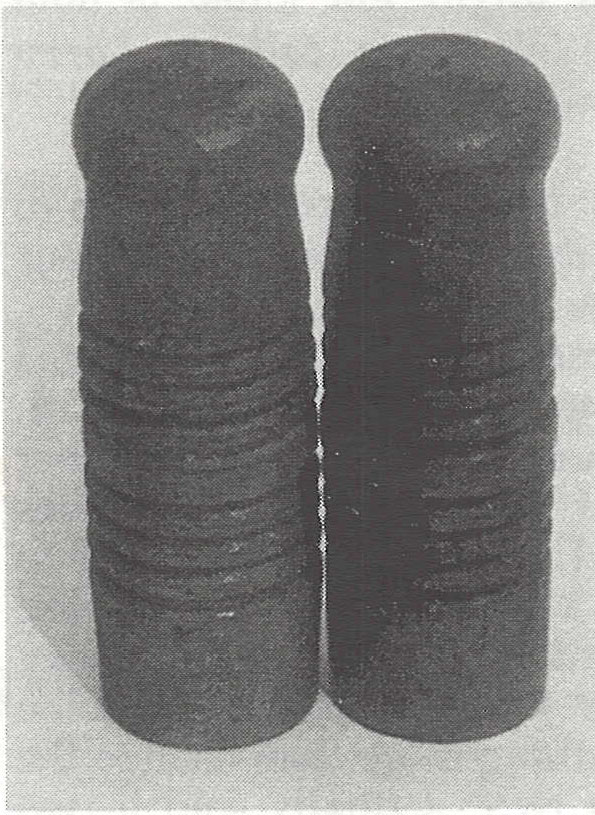
Larry: Well, we made some strange buys when we got started. I remember we bought 850 rear stands. What do you do with all them? Well, I wish I could find 850 more today. Another time we were digging and we found all these wood handlebar grips. Five thousand pairs of them for $125. They were wartime, when you couldn’t get any rubber. We look at each other when we were driving home and wondered what we could get out of these? Harve said people will probably pay 20 or 25 bucks a pair for them. So right away we start counting our chickens, adding all this money up. Finally we settled on $15 a pair and we still figured we’d get rich. Well… we didn’t exactly set the world on fire. We still have boxes full of them, and we get $3 a pair today. Want some?
Harve: Our greatest buys? I’d have to say the Shelly brothers in Elkhart for one. We got about 40 some bikes out of there, paid $10,000 for the whole load. We were home for two days when we sold one highwheeler for $2500. We also got a bunch of Autocycles seats and other rare Schwinn parts. I recall we got 12 hard tired safeties with spring suspensions. Then another big buy came from up in Minneapolis, stuff from the old Island Cycle Supply.
Q: How do you find whole inventories like this?
Larry: We do a lot of business with distributors, and they’ll turn us on to stuff. If you’re fair with people, they’ll keep coming back to you. So we never try to lowball anyone.
Q: Are you still finding new treasures?
Larry: Oh yeah. Just last year, we got a letter from a guy selling a really nice Bluebird. Right after that we got turned on to a good, original Aerocycle. And we know about a ’38 Autocycle with the crossbar speedo, red tires and grips, you name it. Still sitting in a guy’s garage. I’d rate it about a 9 on a scale of 10. It’s just itching to be cleaned up.
Q: Harve? Are there any NOS Whizzer kits in a box still available?
Harve: I just saw one a while back. There are still a few new ones out there. A lot of old dealers just closed up shop and stored their remaining inventory in their garage or barn. Funny story, I remember buying an NOS 700 kit for $80 once. Turns out it came out of the Whizzer factory years before. Some of the employees would throw them over the back fence before they got stamped with serial numbers and sold them for $50. So there was no record of these engines. If you run across a-factory kit without a serial number, it could be one of these.
Q: What do you see in the future for Memory Lane?
Larry: Well, you hear talk lately about how the bike hobby is dying out. But all I can tell you is business keeps getting better and better for us every year. We’ve recently had to add a third building just to display bikes for sale. So we think the hobby is still going strong. Remember a few years ago when you could pull in to Portland on Friday night and still get a spot right up in front? Same goes for here before Ann Arbor. We’re humming the whole week before. We’re still high on the hobby
Now that the Freemont, Ohio meet is history, Memory Lane is as busy the week before Ann Arbor as they are during their Open House in the fall. So be sure and stop by and check out the action. You won’t be disappointed.
? MYSTERY QUESTION?
Why do some H and J cases have this big bolt on the side?
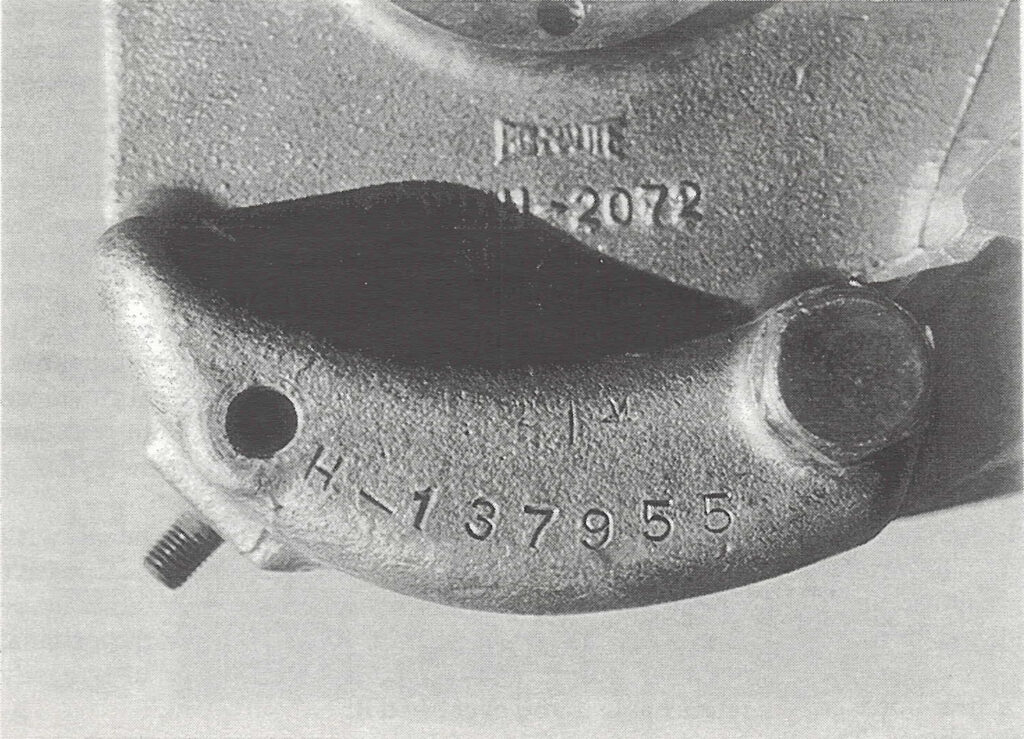
First glance would suggest a place to mount a kick-start pedal. But has anyone ever seen one in this configuration? Besides, there’s no secondary boss to secure the recoil spring. Send in your ideas and the best guess wins a free Com Dog at Portland.
Part 3: “Barn Fresh” to freshly restored
If you recall from the last installment of our engine rebuild article, we began working on my bead-blasted cylinder by cutting the valve seats. So in this issue we’re ready to bore out the cylinder.
After wiping the cylinder clean to avoid any false readings, Al inserted a T-shaped telescoping gauge into the center of the bore at ninety degrees to the wrist pin, where the wear is the highest. .Careful measurements with a 2-3 inch micrometer revealed that the cylinder was a standard now, but a worn standard. So we had to bore to .010 over. Bore jobs, by the way, are determined by the oversize pistons available: .010, .020, .030 and .050. (Whizzer didn’t make a .040.) Nowadays you can also get repro .040 and .060 pistons.
Al got out his SUNEN Jr. Portable Cylinder Hone for small engines. The kit cost him about $300, and includes two set-ups, one for roughing in and the other for finish honing. Obviously, this would be a big investment for the average hobbyist, so there are a couple of alternatives. Most small engine shops will perform this service for $25 to $40. Or you might feel more comfortable sending it to one of the Whizzer rebuilders in your area who is more familiar with these old engines. I know I do.
Al clamped my cylinder in his bench vice and began the first step in the boring process, roughing out to size. He started at the bottom of the cylinder where there was less wear because the rings didn’t ride there. The objective is to start boring until the bare piston (without rings) just slides in the bore. Then we’ll go to the finish honing where we’ll mic more carefully.
The first thing you want to do is get the bore straight. If it doesn’t come out straight, you might have to go to the next size up, which in my case would be .020 over.
Al removed the hone to check our progress. “See how the hone is cutting at the bottom and barely touching at the very top? It’s not doing anything where the rings rode.” As I peered in, I could see the stone marks in the areas he pointed out. Cool. Even I could understand this.
Al paused to reverse the cylinder in the vice to get more even stone wear. After a little more boring we tried inserting the piston again and this time it went in. It was tight, but we were able to slide it back and forth, indicating we needed about .004 more for proper ring clearance. I could still see a little smooth spot where the rings wore the cylinder the most, but these would come out in the finish-boring step.
As we stopped to take a break (boring is a hard, dirty job), Al commented on the “economy job” alternative to boring out a cylinder. “If you just want to put in new rings, you can use feeler gauges between the piston and worn cylinder wall. You slide in .004, .005, then if you begin to feel resistance with a .006 feeler gauge, you can assume it’s still usable. In this case, you’d use a fine hone or sandpaper to scuff up the bore to seat the rings. The problem is, you’ll probably end up with an oval-shaped bore, so the rings will never really be able to seat properly. But not everybody is after perfection — some • guys just want to ride around the block a few times and don’t mind if it smokes a bit. After all, these are SO-year old motorbikes, not new Hondas.”
We checked my new piston with the 2-3″ micrometer at the bottom of the skirt. For a .010 over-bore, the piston should measure 2.250″ plus .006, or 2.256. Remember, specs call for the piston to be .004 under. It’s a good idea to record your measurements on a piece of paper so you have a record of what you’ve done after the overhaul.
Al continued to use the coarse stones as we got closer to the bore we wanted, as the fine stones really don’t remove much material. As we neared our objective of 2.260 for .010 over, he noted that we had 100% cleanout. Remember how we talked about getting the bore straight? The opposite of a barrel-shaped cylinder is called “bell-mouthed,” where the piston would be tight in the center. Neither situation is good.
Al now changed to the fine hones for the finish boring. He likes to take it out to .004, rather than .003 clearance to avoid any chance of seizing the piston. “You ruin the piston, you ruin the bore job, so why take a chance. Most people don’t break in a Whizzer engine anyway. So I’d rather have it on the high end of the tolerance rather than the low end.” I noticed how Al really moves the hone in and out of the cylinder with a pronounced action, to achieve the desired cross-hatching required to hold the oil for good compression.
We went back in with the telescoping gauge to mic out our progress and this time we were right on the money, at 2.260. I guess Al has done this a time or two. (He’s at rebuild #317 now.) We also carefully checked the bore for straightness, to make sure we didn’t go either barrel or bell-mouthed. Right on 60! I dropped the piston in the cylinder and it slid down like a slow elevator in an elevator shaft.
Al feels you can’t clean a cylinder too much after boring. He starts by rinsing most of the cast iron and stone grit out with mineral spirits. A lot of people just stop here, thinking they’ve done the job well enough. But, as Al was about to demonstrate, there is still a lot of cast iron and grit embedded in the cylinder wall that can result in premature wear and failure. He follows the mineral spirits up by washing the cylinder vigorously with hot, soapy water, blowing it dry, then wiping the interior surface with a clean white rag, such as an old t-shirt, wetted with oil. He repeated this several times, and the rag kept coming out black, indicating more cleaning was needed. Finally the rag came out with just the clean oil on it and he was satisfied that the cylinder was free of grit.
After the cylinder was dry we sprayed it with several coats of Krylon Semi-Flat Black #1613. This isn’t a heat resistant paint, but everybody uses it and it never bums. Krylon dries quickly, looks just like the original cylinder paint, and holds up well. It’s also easily retouchable if you ever need it.
Next issue: Final assembly and test run
As One Model to Another…