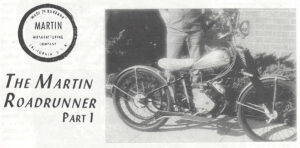
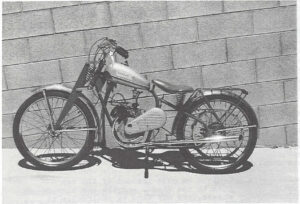
Somehow, the idea of putting high-performance speed equipment on something as anemic as a Whizzer engine seems like a contradiction in terms (like the oxymoron “jumbo shrimp”), but leave it to the guys in California to come up with such an idea.
Actually, the overhead valve modifications are almost as old as Whizzers themselves. The post-war H-engines, anyway. One of the most widely known is the Martin overhead valve. I say widely known, because the only available brochure has been Xeroxed so many times it’s almost illegible. If you have a collection of Bob Baker’s newsletters, you can see it in Issue 43. And for those of you who don’t, the text is as follows:
Martin Racing Equipment
1150 N. Garvey, Pomona, Calif.
The MARTIN overhead valve setup for Whizzers is designed to increase the efficiency of the Whizzer engine as to higher h.p. and r.p.m. By increasing the valve and port size / and placing them directly over the cylinder, a larger charge of gas introduced quicker and the exhaust is expelled faster and easier
The compression has been raised and the combustion chamber designed for fast and even firing. Low or extra high compression ratios are available upon request at no extra cost, but are not recommended.
The MARTIN head will fit any model Whizzer if a 1948 or later carburetor is used, and all models that take 1/4″ head bolts (1947 or earlier) are drilled and tapped for 5/16″ coarse thread.
We have a special carburetor for our overhead that sells for $4.80 plus tax and freight, but the supply is limited and we may not be able to supply you.
The rocker arms and heads are of gray cast iron with a high nickel content. The rocker supports are of mild steel. The push rods are of tool steel. The valves are of heat treated steel. Springs are oversize. The valve head is 1″ in diameter. 7/8″ ports are hand ground for smoothness. A Victor gasket and nine 5/16″ Allen bolts are supplied. Replacement parts are sold at cost plus handling, freight, and tax. Example, rocker arms $1.00 per pair and a few cents freight.
A Whizzer equipped with a Martin head recently attained a speed of 64 m.p.h.
Although we do not recommend such high speeds with a bicycle frame and brakes, it shows what is possible with a well-tuned engine and a MARTIN head.
The most noticeable gain with a MARTIN head is in h.p., which will make it easier going on rough ground or a steep grade, although with proper carburetor adjustments, top speed is very fast.
A MARTIN overhead complete only $22.50 plus tax and freight (COD)
PORTING INSTRUCTIONS 31/32 SPRING VALVE $2.50 EA.
Now, here’s the rub with Martin heads. According to every present-day collector I have talked to, no remaining Martin OHV heads exist in collectors hands today. Do you have one? If so, write in and I’ll do a story on it. You’ll be sure to gain instant fame, at least among these circles.
Scott Heads
Less well known, but very tangible, are Scott heads from the early 50’s. Several people have Scott heads today, including Homer Knapp, from North Hollywood, California, who owns several versions and still keeps in touch with Mr. Scott. I spoke with Homer recently on the phone and he filled me in on some of the details which I’ll share with you here.
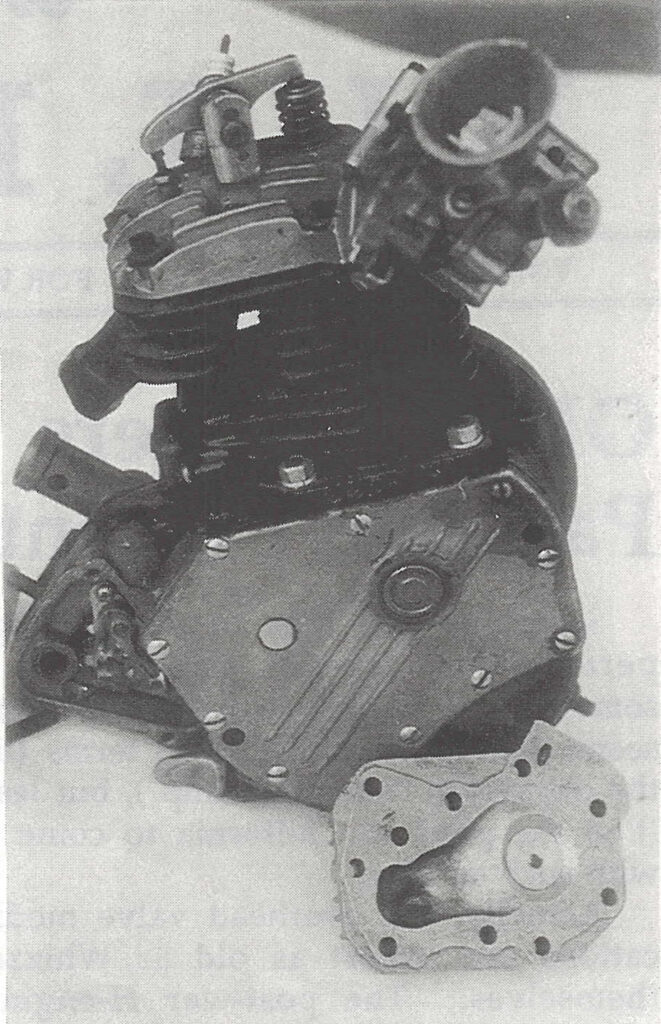
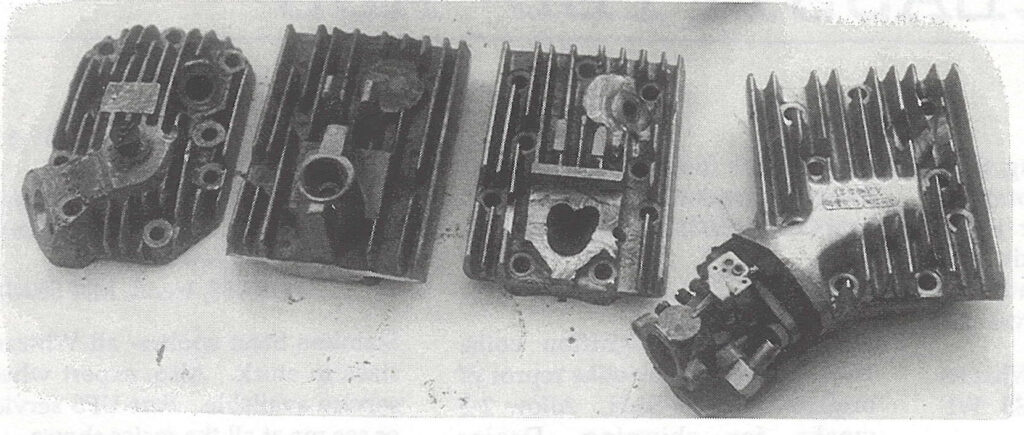
Scott overhead valve head from early 50’s with single exposed rocker arm. Courtesy Homer Knapp
Mel “Monk” Scott was working in a machine shop in Santa Monica when he designed his first Whizzer OHV head back in 1953, and he is still well-known among drag racing circles for his Scott fuel injection systems. In designing his prototype Whizzer OHV head, Scott started with a standard H head and added beeswax to fill up the unused half of the chamber where the intake valve was. He also used beeswax to build up a new carburetor intake. The new design used a standard Whizzer exhaust valve, but a rocker stand was now cast on top for the overhead intake valve, which sat over the piston. The push rod for the single overhead valve traveled up through the intake guide and through a hole in the head to mate with the rocker arm which sits on an angle across the head. The whole setup was similar to the Riley F-head configuration on old Ford Model A and B hop-up kits.
In addition to the OHV head described above, Scott experimented with a second version of the same casting, only this time with a “voluntary” intake valve with no push rod or rocker arm, but just a weak spring which allowed the fuel-air mixture to be drawn in on the intake stroke. This was similar to the “atmospheric” engine design found on early motorcycles.
Scott dropped out of the Whizzer scene in the mid-50’s to pursue other interests, but got interested in Whizzers again in the mid-80’s when he came up with a reed valve intake design inside the combustion chamber, similar to that of air compressors.
Enter Fred Koehnke
If this name sounds familiar, it’s probably because you’ve met Fred at the Whiz-In or Portland or any of a dozen other major shows around the country. Fred and his brother John both live in Yorba Linda California and are well-known on the Whizzer scene, having built-up many innovative and award-winning bikes. I’ll let Fred tell you about the OHV Whizzer engines he created:
“Back in the early 1980’s; I was running my Hot Rod Roadmaster Whizzer at the Antique Drags at the Orange County International Raceway. It had a lightly modified H-motor, home-ground cam, 1/8” overbore, .950 big valves, a modified H low-fin head and Mikuni 20 mm carb.
“But let’s face it — even a modified Whizzer is no rocket ship down the 1/ 4 mile! Most of the Whizzers were running between 40-45 mph with an ET of 27 to 29 seconds, and my bike would run at about 50 mph and 26 ET. So I thought that if I could build an OHV motor with more horsepower, I could run 5-6 mph faster.
Working in a Race Prep Machine Shop, I learned a lot about cylinder head work. Flathead motors like a Whizzer require countless hours of porting and flow bench work to gain small increases in horse-power. But an overhead valve configuration offers easy horsepower, more efficient combustion and longer valve life. Three to four hp over stock is easy to get!
“Working with only a rough sketch and a billet block of aluminum, I began removing material on a Bridgeport mill –starting with valve guide and rocker arm clearance, and a proper oil return cavity via gravity flow. Intake and exhaust port machining was next, followed by valve seat diameters, combustion chamber and spark plug location for optimum perform-ance. Cutting the cylinder head cooling fins took the most time! Total time in the project? About 4 hours a night for one month. But it all paid off in my first run at the drag strip — 59.86 mph and an ET of 23 seconds in the quarter mile. The engine was surging a little bit, so after rejetting the carburetor my next try at the drags resulted in 62.03 mph and 22 sec. ET. Estimated horsepower is 7-1/2 hp at 7500 rpm.
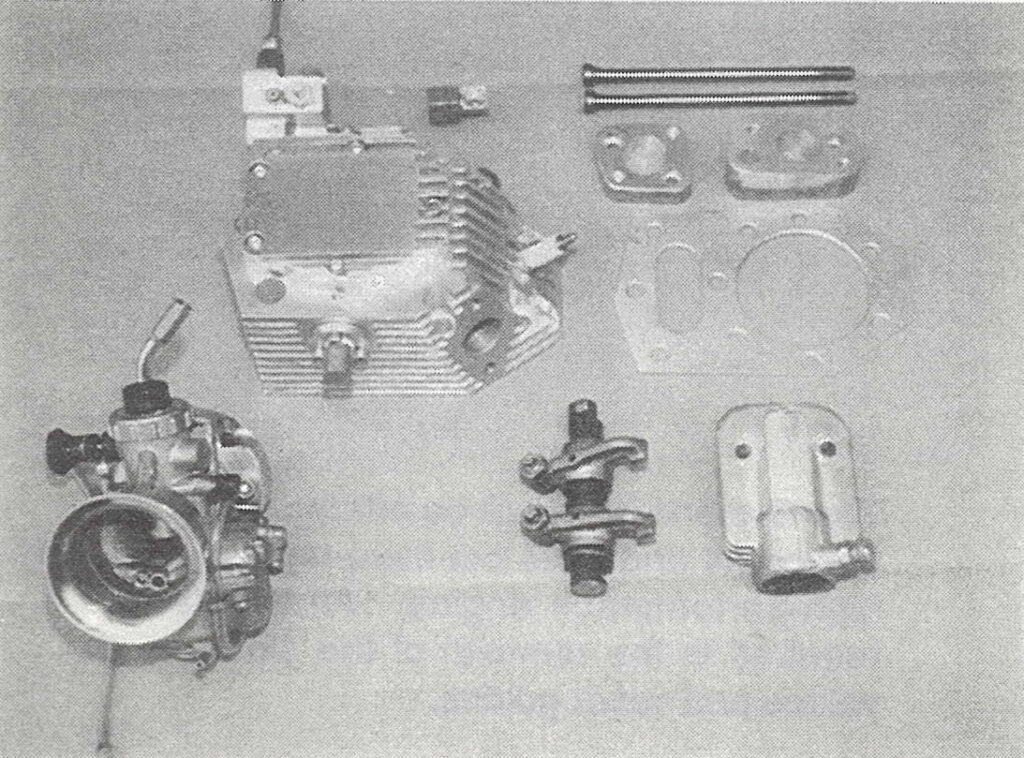
My second OHV engine was a much lower profile design. The valves run in a horizontal plane above the piston. Valves are stock 7/8″ Whizzer cut to a shorter length. The hand-built rocker arms have a 1-1/2 to 1 ratio. The rocker arm assembly is lubricated by a plunger type oil pump driven off the bottom of the exhaust cam lobe. Compression ratio is kept to 10 to 1 by using a 1/8″-over piston with a .250 dome.
Fred’s second design features hoizontal valves for a lower profile. Valves are assembled and adjusted by removing top and rear covers.
The Chicago connection
Hey, guys, you can’t keep it all in California. About four years ago, Al Blum decided to craft his own OHV Whizzer and the results are shown on the next page..
As Al tells the story:
“Word kept filtering back to the Midwest about the hopped-up Whizzers at the Whiz-In and Orange County drag races. So Reg Williams, Larry Anderson and I built up some race bikes. Typically they were bored out an eighth, with Weber cams, Mikuni carbs and stroker kits from Kenny Thomas. That gave us 165cc compared to the standard 138cc. Not exotic, but a lot faster than your average Whizzers we were riding at the Sunday breakfasts.
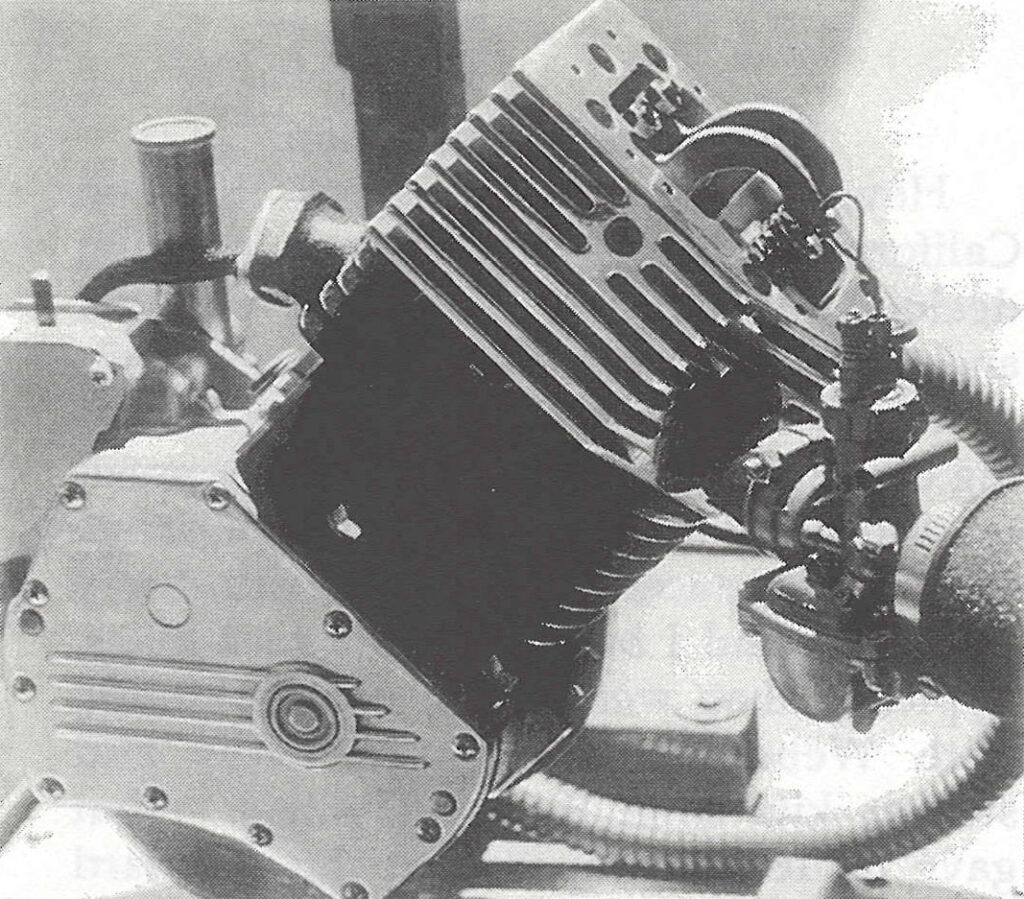
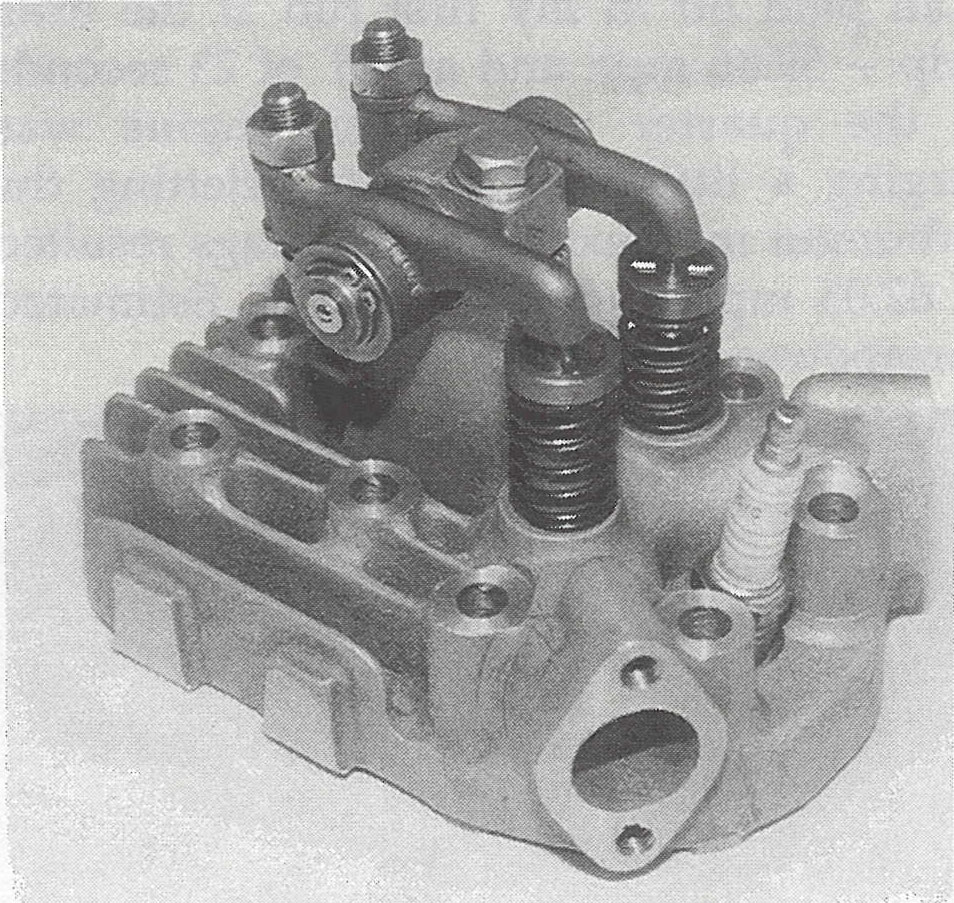
Then about three years ago I decided to try my hand at building an OHV Whizzer, starting out with a raw block of aluminum. I also wanted to see if I could do it with basic equipment in my home shop. Certain things were a given, like the head bolt pattern, cam and piston locations. I actually turned the combus-tion chamber on my South Bend lathe, leaving one of the jaws out of my four jaw chuck for the swing.
Al Blum’s OHV head, shown here with the valve cover removed, is mounted on a standard H engine with a roller crank and 1/8th overbore cylinder.
The distance from the push rods to the valves determined the length of my rocker arms — about 2-1/2 in. The rocker arm is a simple lever, and the position of the pivot point determines the ratio, or mechanical advantage of the arm. So, where the original valve ran something like 156-thousandths on a standard cam in the L-head configuration, we’re now operating the valve about 250 thousandths.
Milling the fins took the most time. I wanted to remove as much material as possible to dissipate heat. I also put in bronze valve guides. I’m running the head on a standard H motor with a roller crank and a cylinder bored out an eighth. Performance is snappy, with real good throttle response.
And now, the Cyclone!
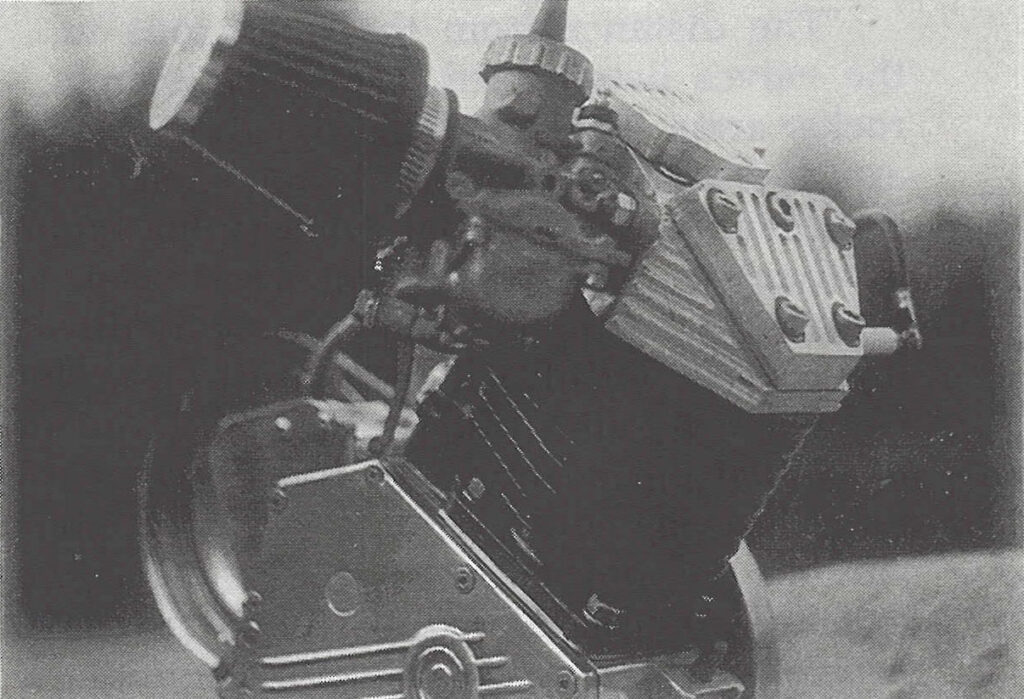
The latest entry on the scene, also from Chicago, is an exposed rocker arm head designed by Tony Verschoore. This design is still in the prototype stage, but will be manufactured in small quantities and offered for sale in the near future. Tony has been involved in antique cars for years, building OHV heads for four cylinder Fords from raw castings. So what would be more natural than designing an OHV head for a Whizzer? Tony’s OHV head (figure 4) is cast aluminum and heat treated for dimensional stability. It uses hardened valve seats for unleaded fuel, and Briggs & Stratton exhaust valves. At this time, two bikes are being built up and as soon as the ice is clear from the streets they will be conducting test runs. Tony has named his new head the Cyclone! Hey, guys, that sounds kinda neat for a Whizzer, right?
The Cyclone head will be offered as a bolt-on kit and does not have to be a high-performance engine. All that is required is the removal of the old valves and valve guides.
Have any of you readers had experience with Whizzer OHV heads? If you have any literature or close-up pictures, especially the early stuff, send them to me and I’ll include them in a future issue.
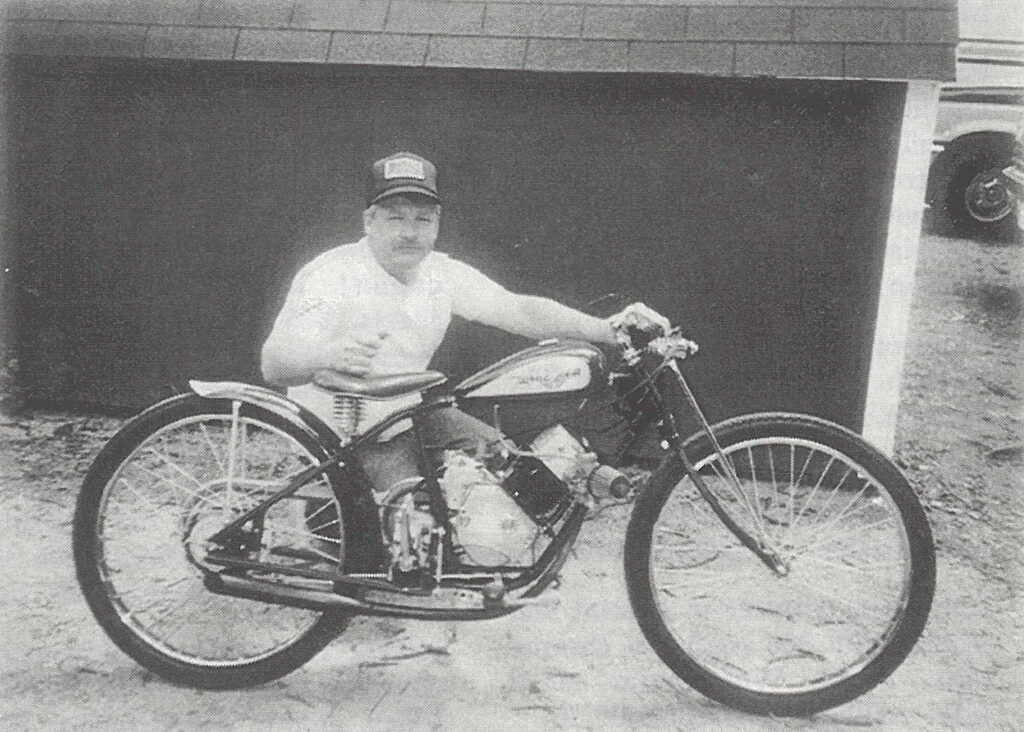
A collection of early Scott heads, courtesy of Homer Knapp. Reed valve heads are shown on the right.One of the specially modified frames Fred built up to provide the extra clearance required for an OHV engine. Early runs through the time traps resulted in “tankslapping” front end shimmy. So Fred turned a solid aluminum plug to replace the spring in the spring fork.
Note: Due to the length of the OHV feature story, there will be no installment of the “Barn Fresh” series this month. In March, we will finish the valve job, go over the carburetor and with luck, assemble and test-run the engine.
Book Review: I recently had the opportunity to read Willard Larson’s Scrapbook of Antique Motorscooters and Motorbikes. I had already read his History of the Whizzer and was suitably impressed. But this book really brought back memories. (I bought a Doodlebug for $15 with my paper route earnings when I was thirteen, and have never had as much fun since, although I keep trying). Never mind the quality of the Xeroxes, if you had or coveted any of the motorized bikes in Larson’s book, you will be highly entertained.